

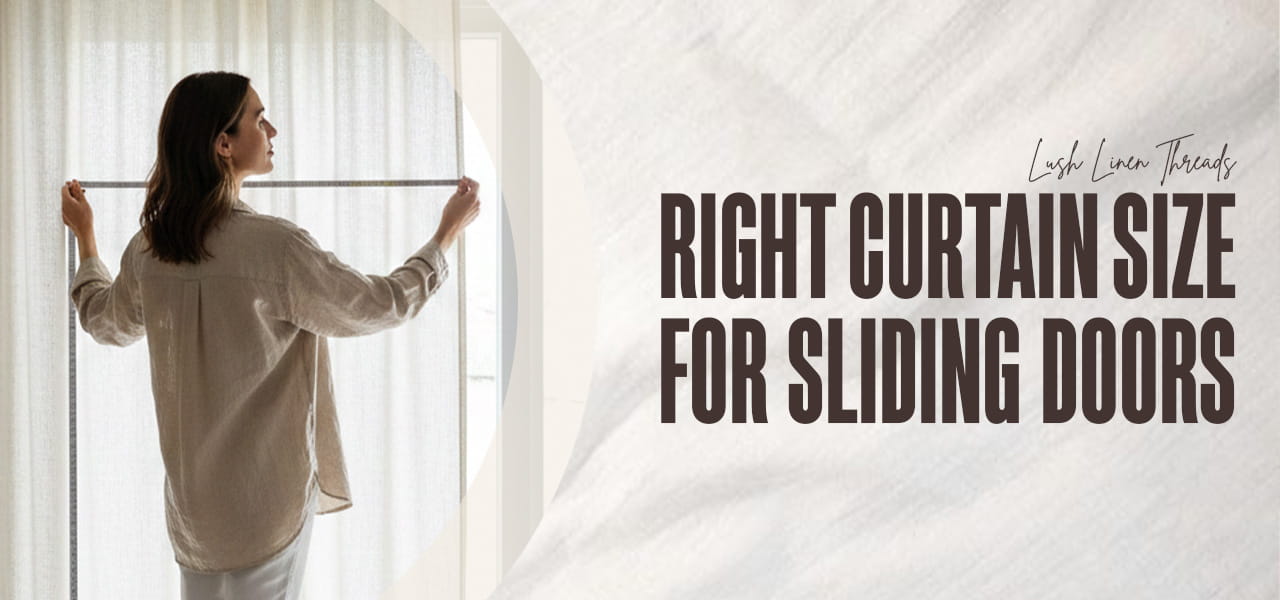
The right curtain measurements for sliding glass doors begin with the rod or track width, then come down to choosing a length and panel setup that suits everyday use. At Lush Linen Threads, the goal is simple: better coverage, a cleaner drape, and curtains that feel right in real life.
Quick Answer for Sliding Glass Door Curtain Measurements

If you want the fast version, here is the easiest way to think about it:
-
Measure the full rod or track width, not just the glass.
-
For most homes, 2x fullness is the safest starting point.
-
Add return on both outer edges and overlap at the center to reduce light gaps.
-
For a frequently used door, a finished length that sits about 0.5 inches above the floor is usually the easiest to live with.
-
Before ordering, always confirm whether the listed width is per panel or per set.
That simple framework prevents most of the problems people notice after installation: curtains that look flat, hems that drag, or panels that seem wide enough in theory but still leave side gaps once the lights are on.
Standard Sliding Glass Door Starting Points
If you want a quick reference before working out curtain measurements for sliding glass door spaces, many standard sliding glass doors are around 72 inches wide and about 80 inches high. That usually means you need more total curtain width than the door itself if you want the panels to look full and close properly.
For many homes, that puts the combined curtain width somewhere around 140 to 150 inches for a balanced everyday look. For length, 84-inch panels are often the minimum starting point for a standard sliding door, while 96-inch or 108-inch curtains work better when the rod is mounted higher for a taller, more finished look.
These are useful starting points, not final answers. Your own rod placement, ceiling height, header style, and floor conditions still matter more than any standard-size shortcut.
Measure These 3 Numbers First
Before you compare fabrics, lengths, or panel sets, write down the three measurements that matter most for fit.
Hardware width
This is your real coverage line. Measure the rod or track from end to end, because that is the span the curtains need to cover when closed.
A common mistake is measuring only the glass area or door frame. That usually leaves you short on the width needed for fullness, side return, and center overlap. Even if the curtains can technically close, they may still look narrow or feel less private than expected.
Finished length
Finished length is the drop from the true hanging point down to where you want the curtain to end. That starting point depends on the header style, so do not assume the top of the rod is always the right place to begin.
A measurement that looks correct on paper can still end up short if you forget that rings, clip rings, pleats, or track hooks change where the fabric actually begins to hang.
Stack-back space
Stack-back is the wall space the curtains need when fully open. On sliding doors, this matters more than people expect because it affects how open the doorway feels during the day.
If the panels are wide, heavily lined, or extra full, they need more room to sit neatly when opened. If stack-back space is limited, the doorway can start to feel crowded even if the curtains look good when closed.
Start With the Rod or Track, Not the Glass
When measuring curtains for a sliding glass door, the rod or track should always come first. Curtains hang from hardware, not from the glass itself, so your measurements need to match how the panels actually sit when opened and closed.

Where to start measuring by header type
Different header styles change the true starting point of the drop.
-
Grommet curtains: measure from the grommet line
-
Ring or clip-ring curtains: measure from the ring eye
-
Pleated curtains: measure from the hook position
-
Ceiling-track curtains: measure from the track line
This is why two curtains with the same labeled length can look different once installed. The header changes where the visible fabric starts.
How far should the rod extend past a sliding glass door
The rod usually needs to extend beyond the sliding door frame on both sides. That extra width helps the curtains cover the edges more effectively when closed and stack back more cleanly when open.
This matters because sliding door curtains do more than frame the opening. They also need to manage privacy, reduce edge light, and avoid crowding the usable doorway. A setup that stops too close to the frame often looks tighter and functions less smoothly.
Common measuring mistakes that cause gaps
Most fitting problems come from a few repeated mistakes:
-
measuring the glass instead of the rod or track
-
skipping return and center overlap
-
choosing length from the wrong hanging point
-
underestimating stack-back
-
assuming every product listing shows the width the same way
On a standard window, small measuring errors may go unnoticed. On a sliding door, they are much more obvious because the opening is wider, the curtains are used more often, and the center split is easier to see.
How Wide Curtains Should Be for a Sliding Glass Door
Width is not only about covering the opening. It also affects how full the curtains look, how softly they drape, and how stable they stay when the fabric shifts with movement or airflow.
Choose the right fullness ratio
Fullness is the amount of fabric compared with the rod or track width.
For most sliding glass doors, these are good starting points:
-
1.5x fullness: cleaner and more minimal, often best for heavier or lined curtains
-
2x fullness: the best everyday default for most homes
-
2.5x fullness: softer and more generous, especially good for sheers
If the combined curtain width only matches the hardware width, the panels often look flat once closed. They may cover the opening, but they rarely look intentional.
For most people, 2x fullness is the easiest choice because it balances softness, privacy, and practicality without becoming too bulky.
Add return and center overlap
Fullness alone does not solve coverage. You also need return and overlap.
Return is the extra fabric that wraps back toward the wall at each outer side. It helps block bright strips of light near the brackets and gives the curtains a more finished look.
Overlap is the extra width where the two center panels meet. Without enough overlap, the curtains can separate slightly in the middle when someone walks by, when the air shifts, or when the fabric relaxes during daily use.
A practical starting point is:
-
2 to 4 inches per side for return
-
3 to 6 inches total for center overlap
These small additions often make the difference between curtains that only look fine in daylight and curtains that still feel properly closed at night.
Example: a simple width calculation
Let’s say your rod width is 100 inches.
If you want a full but practical look, start with 2x fullness:
100 inches x 2 = 200 inches total fabric width
That total gives you a realistic target before you compare panel options. If the combined width of the panels you are considering falls well below that number, the curtains may still close, but they can look stretched flat instead of softly draped.
This is also why checking return and overlap matters. Even when the total width seems reasonable at first glance, a setup can still feel skimpy once you account for edge coverage and center closure.
Best Curtain Length for Sliding Glass Doors
Length affects both the look and the practicality of the curtains. A sliding door is a high-touch area, so the best finish is usually the one that survives real daily use, not only the one that looks best in a styled photo.

The safest everyday length for high-traffic doors
For most homes, a slight hover above the floor is the most practical option. About 0.5 inch above the floor usually gives a clean finish without turning the hem into a dust trap.
This works especially well if:
-
The door is open often
-
The curtains move daily
-
Kids or pets pass through the area
-
You want a polished look with less maintenance
A slight hover tends to stay cleaner and easier to manage than a floor-touching hem in a busy room.
What to do if the floor is uneven
Uneven floors are common, especially across wider openings. The simplest way to handle them is to measure the drop in three places:
-
left
-
center
-
right
If you want the curtains to hover, use the shortest point as your guide. That keeps the hem off the floor across the full width of the opening.
If you want the curtains to touch the floor, you may need to adjust after installation or choose hemming more carefully. A floor-touching finish can look beautiful, but it is less forgiving when the floor line is not consistent.
How vents, heaters, and floor obstacles affect the drop
Baseboard heaters, floor vents, and similar obstacles can change what “best length” means.
If the curtain hem sits directly over an active vent or too close to a heater, the fabric can collect dust faster and feel less practical in daily use. In these cases, it is often better to go slightly shorter rather than force a perfect floor touch.
A practical curtain should work with the room, not fight it.
How Many Curtain Panels Do You Need
Once you know your width target and preferred length, panel count becomes much easier. This is the point where measuring turns into a shopping decision.
A simple way to match panel count to your target width
Start with your hardware width, then multiply by your chosen fullness ratio. That gives you the total amount of curtain width you want when the panels are closed.
From there, compare that number with the actual width of the panels you are considering.
Two panels often work well for moderate openings, especially when you want a clean center split. For wider sliding doors, more panels can help the fabric distribute more evenly and stack back more neatly when opened.
Panel count is not just about whether the curtains can close. It is about whether they will look balanced and function smoothly every day.
How to read panel width in product listings
This is where many buying mistakes happen.
Some listings show the width of one panel. Others show the width of the full set. If you do not confirm which one you are looking at, it is easy to buy less width than you really need.
It also helps to check:
-
whether the listed width is the finished width or the flat fabric width
-
whether the curtains are lined
-
what header style is being shown
-
whether the product is meant for decorative framing or full closure
These details matter more on sliding doors because the opening is larger and any sizing mistake is more visible.
Quick buying check before you order
Before you buy, run through this quick checklist:
-
Measure the full rod or track width
-
Choose your fullness ratio
-
Allow for return and overlap
-
Confirm the correct drop from your real hanging point
-
Check whether the width is listed per panel or per set
-
Make sure the panel count supports your target width
-
Think about stack-back so the doorway still feels usable
That short review usually prevents the most common mistakes: underbuying width, choosing the wrong drop, or ending up with panels that feel fine on paper but disappointing in the room.
Choosing Linen Curtains for a Sliding Glass Door
Once your measurements are clear, the next step is choosing a curtain style that fits the way the room actually works.

When linen works best
Linen curtains work especially well on sliding glass doors when you want the space to feel softer, lighter, and more relaxed without looking unfinished.
They are a strong choice when you want:
-
a natural drape
-
filtered daylight
-
visual softness across a large glass opening
-
texture that feels elevated but still easy to live with
In a lifestyle-focused home, linen can make a sliding door feel more integrated with the rest of the room instead of standing out as a large, hard surface. If you are styling beyond the window itself, linen home accessories can help keep the room feeling soft and cohesive.
What to check before choosing panel style and lining
Before you choose a linen curtain setup, think about the practical side as carefully as the visual one.
Check:
-
How much privacy do you want at night
-
Whether the room gets strong direct sun
-
Whether you want a lighter look or more structure
-
How much stack-back space do you have
-
Whether lining changes the feel or the thickness you want
If privacy matters more, lining and overlap may matter more than pure softness. If you want a lighter, airier finish, the drape and fabric feel may take priority. The best result usually comes from matching the curtain to the room’s actual use, not just the image you have in mind.
At Lush Linen Threads, that decision tends to feel much easier once the measurements are already settled.
Common Questions About Measuring Curtains for Sliding Glass Doors
For curtain measurements for a sliding glass door, do you measure by the door or the rod?
Measure by the rod or track. That is the span the curtains actually need to cover when closed, and it is the only reliable way to plan fullness, return, and overlap.
How wide should curtains be for a sliding glass door?
Use the full rod or track width, then multiply by your chosen fullness ratio. For most homes, 2x fullness is the safest everyday starting point.
What is a good fullness ratio for sliding door curtains?
Most setups look best at 2x fullness. If you want a cleaner look or are using heavier-lined curtains, 1.5x can work. If you want softer sheers, 2.5x may look better.
What curtain length works best for a high-traffic sliding door?
A slight hover above the floor is usually the most practical everyday option. It keeps hems cleaner and helps avoid snagging.
Are curtain widths listed per panel or for the full set?
It depends on the product listing, which is why this is one of the most important checks to make before ordering. Always confirm whether the stated width refers to one panel or the full set.
Where do you start measuring if you use rings or clip rings?
Measure from the ring eye down to the floor or your chosen finish point. Starting from the top of the rod often makes the curtains come out too short.
Getting curtain measurements for sliding glass doors comes down to a few practical decisions: the correct width, enough fullness, proper overlap, and a length that suits everyday use. At Lush Linen Threads, that measure-first approach makes it much easier to choose linen curtains that look balanced, feel functional, and fit the room with confidence.


