

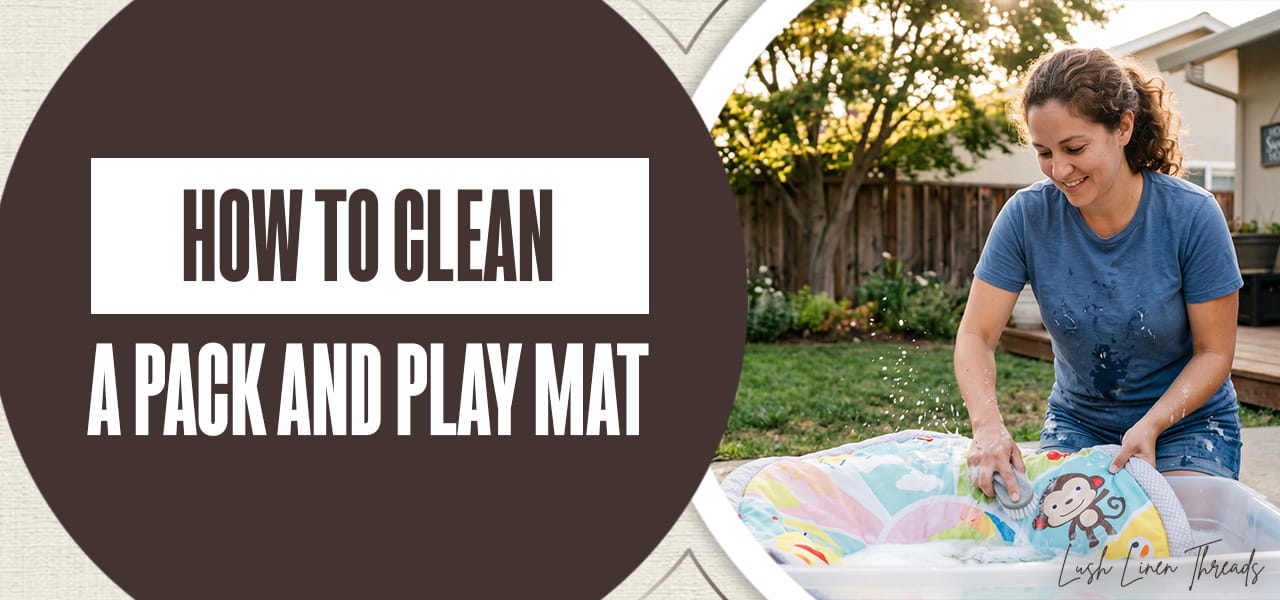
If you’re learning how to clean a pack and play mat, start with a gentle, low-moisture routine that protects the surface, seams, and inner layers. This Lush Linen Threads guide keeps cleanup simple for everyday messes, light odor, and safe drying before your baby uses the mat again.
How to Clean a Pack and Play Mat Quickly and Safely
For most routine messes, the safest order is simple: blot first, wipe gently with mild detergent on a cloth, remove residue with a plain-water wipe, then dry flat with strong airflow and extra attention to the seams.

The 60-second method
For most routine messes, follow this order:
Blot → wipe with mild detergent → wipe with clean water → air-dry flat → check the seams.
The cleaning step may be quick, but drying should not be rushed. Seams and stitched edges can stay damp longer than the center of the mat, especially after urine, milk, or spit-up.
Choose the Right Method by Mat Type
Use this table as your quick “what should I do?” reference:
|
Mat type |
Most common mess |
Cleaner choice |
Rinse step? |
Drying rule |
Seam risk |
|
Wipe-clean vinyl/PU pad |
Everyday refresh |
Mild detergent on a cloth |
Yes, plain-water wipe |
Dry flat with airflow |
Low |
|
Wipe-clean vinyl/PU pad |
Pee/spit-up |
Mild detergent; enzyme only if needed |
Yes, important |
Give seams extra airflow time |
Medium |
|
Removable fabric cover |
Daily use/smells |
Mild detergent, gentle cycle |
Extra rinse if stiff |
Air dry default |
Medium |
|
Quilted pad/foam core |
Pee/milk |
Minimal moisture + mild detergent on cloth |
Yes, always |
Longer drying + seam checks |
High |
|
Waterproof layer + stitched edges |
Musty odor |
Minimal moisture; avoid soaking |
Yes, remove film |
Fan + seams first |
High |
|
Any type |
Sick household |
Disinfectant per label |
Rinse if required |
Ventilate + fully dry |
Varies |
If your manual says wipe-clean only, use the same order with less moisture and no soaking.
Enzyme cleaners may help with stubborn organic odors, but they are not the default for routine cleaning. Use them only when appropriate for the material and always follow the product and manufacturer's instructions.
Before cleaning, check the care instructions for your specific playard model. Pack and play mats are not all built the same, and some have cardboard-like inserts, foam padding, or stitched seams that can be damaged by soaking. If the mat becomes warped, soft, lumpy, or hard to dry completely, replace it instead of using it again for sleep.
Match the Mat Type to the Mess
Before you start, identify the mat type and the kind of mess you are dealing with. That quick check helps you choose the right amount of moisture, avoid over-wetting the seams, and get a result that stays fresh longer.

Check the manual before you start
Before you grab a cloth, check the playard manual and any care label on the cover. Different models use different materials, and that is often where cleaning mistakes begin. If the cover label and the playard manual differ, follow the manufacturer’s guidance for the mat itself.
This step matters most for foam-core mats, waterproof layers, and any surface used regularly for infant sleep or play, because some materials are not meant to be saturated. Also, check that the mat is still flat, firm, and fitted correctly after cleaning. If the surface becomes warped, lumpy, soft, peeling, or difficult to dry, cleaning is no longer the main issue. Replacement may be safer than trying to keep using a damaged mat.
3 cleaning mistakes that make odor come back
Most repeat odor problems come down to the same pattern: too much moisture, too much cleaner, or drying that stops too soon. If you avoid those three problems, most everyday cleanups stay simple.
Identify your pack and play mat type
You don’t need a perfect match—just pick the closest type so you don’t use the wrong approach.
A wipe-clean vinyl/PU pad usually feels smooth and wipes easily. A removable fabric cover often has a zipper or Velcro and may be machine washable. A quilted pad or foam core tends to absorb more and needs controlled moisture. And a waterproof layer with stitched edges often looks neat and practical, but those stitched edges are at a higher risk for trapped moisture, so drying matters even more.
Match the method to today’s mess
Now name the situation you’re actually cleaning for. Is this just a quick refresh from crumbs and drool? Does the surface feel sticky after drying (that “film” feeling)? Was it pee, milk/spit-up, or a musty smell that shows up in humidity? Or are you cleaning during a sick week and considering disinfecting?
If odor returns after drying, the problem is usually trapped seam moisture or leftover detergent film, not a need for stronger soap. For most routine messes, a careful clean, a plain-water wipe, and full drying matter more than harsher products.
What you need
You can keep this simple. Most of the time, you only need two clean cloths, a small bowl of water, a mild detergent, and a fan. A handheld vacuum, a soft brush, or an enzyme cleaner for stubborn organic odor can help, but the cleaning method matters more than the product list.
A Simple Daily Routine to Keep the Mat Fresh
On most days, you don’t need a deep clean. This routine is just enough to lift crumbs and grime, rinse off any film, and dry the seams properly so the mat stays fresh until the next use.

Step 1: Start dry (crumbs first, seam scan second)
On regular days, start dry so you do not turn crumbs into streaks. Remove the fitted sheet or cover if possible, shake out debris, and do a gentle vacuum pass if you have a handheld vacuum. Then check the seams and edges, because those areas dry slowest and are the first places odor can begin. Before cleaning, check for tears, peeling waterproof layers, broken stitching, or signs of trapped moisture along the edges.
Step 2: Clean in small sections (detergent on cloth, not on mat)
Dampen a clean cloth with water, then add the detergent to the cloth rather than directly to the mat. Two to three drops are usually enough. Work in small sections with light pressure. If you are dealing with a spill, blot first and then wipe gently. Avoid hard scrubbing, which can spread the mess and push moisture deeper into the seams.
Step 3: Rinse, wipe, and dry fully, with extra attention to seams
After cleaning, do a second pass with a cloth dampened with plain water to remove any leftover detergent film. Then dry the mat flat with steady airflow from a fan, giving extra attention to seams and edges, which can stay damp even when the center feels dry.
Two quick checks before you reassemble the mat
If you want an easy “is this really dry?” check, press a dry tissue along seam lines for a few seconds. If the tissue picks up moisture, keep drying. Another quick clue is temperature—if seams feel cooler than the center, they’re still holding moisture.
At the end of a regular-day clean, remember this shortcut: if the surface feels coated, add a rinse wipe; if anything smells off, add airflow time.
How to Remove Pee Odor Without Covering It Up
When there’s pee, milk, or a stubborn stain, the goal is the same every time. Get the mess out fast, wipe away any leftover film, and dry the seams completely so the smell doesn’t come back after it “seems dry.”
Pee/urine odor: Remove source, don’t mask
Treat pee odor as a source-removal problem, not a fragrance problem. Blot thoroughly first to lift as much moisture as possible. Then clean gently with a damp cloth and mild detergent, follow with a plain-water wipe, and dry the seams with strong airflow. If the odor returns after drying, repeat the same gentle clean-rinse-dry cycle instead of adding more soap or fragrance.
Milk/spit-up: Film is the real problem
Milk and spit-up often leave behind a thin residue even when the surface looks clean. Blot first, wipe gently, and treat the plain-water wipe as essential rather than optional. Once the film is removed, full drying usually solves the remaining odor problem.
Stain playbook: Pick the stain type (lift, don’t scrub)
Stains respond better to repeated gentle passes than to aggressive scrubbing. For protein stains such as milk or spit-up, blot first, wipe gently, then rinse. For oil-based messes such as lotion or cream, use the smallest effective amount of detergent and rinse thoroughly so the surface does not stay slick. For dirt rings, several light passes usually work better than grinding at one spot.
If the cover is removable: Machine-wash rules
If your cover is removable and the label allows machine washing, keep it gentle. A gentle cycle and mild detergent are usually enough. If it dries stiff or smells soapy, add an extra rinse. Air drying is the safest default, and low heat only makes sense when the label clearly says it’s okay.
What Not to Use on a Pack and Play Mat
Stronger products are not always better. Most repeat odor problems come from trapped seam moisture, leftover detergent film, or drying that stopped too soon.
- Do not soak the mat unless the manual clearly allows it.
- Do not pour cleaner directly onto the surface; apply it to a cloth instead.
- Do not overuse detergent, because residue can leave the mat sticky or dull.
- Do not use bleach unless the manufacturer specifically says it is safe.
- Do not use high heat to rush drying; airflow is safer than direct heat.
- Do not rely on fragrance to fix odor, because scent does not remove the source.
- Do not store or reassemble the mat while hidden moisture may still be trapped along the edges.
Avoid adding extra padding, thick blankets, or loose layers to make the mat feel softer. For sleep, the surface should stay firm, flat, and used as directed by the manufacturer.
Common Problems After Cleaning and How to Fix Them
If the mat still feels off after you cleaned it, don’t start over from scratch. Most of the time, it’s either leftover film or seams that weren’t fully dry, and a small adjustment fixes it fast.

Sticky / coated feel after drying
If the mat feels tacky after drying, detergent film is usually the cause. Wipe it again with plain water and dry it fully. Next time, use less detergent and keep it on the cloth instead of the mat.
Musty smell returns the next day
If a musty smell comes back the next day, the seams or edges are probably still holding moisture. Lay the mat flat, use a fan, focus airflow along the stitched areas, and keep drying until the seams no longer feel cool or damp.
Stiff cover/smells soapy
A stiff or soapy-smelling cover typically means too much detergent or not enough rinsing. An extra rinse cycle and air drying with airflow usually brings it back to neutral.
Dark seam lines or odor along the edges
If odor seems concentrated at edges, assume those seams are trapping moisture. Avoid soaking, use minimal moisture on your cloth, and dry seams first with steady airflow.
Can You Wash a Pack and Play Mattress?
Most pack-and-play mattresses or mats should not be machine-washed unless the manufacturer clearly says it is allowed. Many mats have foam cores, waterproof layers, or stitched edges that can trap water if soaked.
For the mat itself, spot cleaning is usually safer. Use a damp cloth, a small amount of mild detergent, a clean-water wipe, and full air drying. If the cover is removable and the care label allows it, wash the cover separately on a gentle cycle.
Do not put the mat back into the playard until the seams and edges are fully dry. If it becomes warped, lumpy, peeling, or hard to dry, replacement is safer than repeated deep cleaning.
When Cleaning Is Enough vs When to Disinfect
Most days, a normal cleaning is enough. Save disinfecting for the times it truly matters, then focus on a full dry and smart storage so you don’t end up chasing that musty smell again later.
When disinfecting actually makes sense
For routine crumbs, drool, and everyday messes, cleaning is usually enough. Disinfecting is best reserved for illness-related cleanup or higher-risk messes.
Disinfecting isn’t required every time you clean. It’s most useful when someone in the home has been sick, and the mat was used during that time, or after higher-risk messes you want to treat more carefully.
How to disinfect without leaving film
If you choose to disinfect, follow the product label for dilution, contact time, ventilation, and rinse instructions. For surfaces used by babies and young children, residue matters just as much as odor control. If the label requires rinsing, rinse fully. A plain-water wipe after the required contact time can also help reduce leftover film when appropriate.
Drying + storage rules that prevent re-odor
If you want odor not to come back, storage is as important as cleaning. Don’t reassemble or store the mat while it’s “almost dry.” That last bit of moisture—usually hiding along seams—is what turns musty later. Dry flat with airflow, keep bedding off until fully dry, and extend seam drying in humid rooms.
When to replace instead of cleaning
Replace the mat or cover if:
- Odor returns after multiple proper clean-rinse-dry cycles
- Foam is breaking down, warped, or lumpy
- Seams no longer dry reliably
- The waterproof backing is peeling or cracked
- There is visible mold
- The manual says the damaged part should not be reused
If the mat is damaged, warped, or difficult to clean safely, it may be time to consider a washable play mat or a softer, everyday surface that is easier to care for. This is especially useful for families who want a cleaner floor setup for tummy time, crawling, and daily play outside the playard.
Simple Habits That Prevent Bigger Cleanups
A few small setup choices can save you a lot of cleanup later. With a simple protective layer and a consistent routine, most messes stay quick, and you rarely need a full deep clean.
Protective Layers: Fitted Sheet or Removable Cover
If you want fewer deep cleans, protective layers do a lot of quiet work. A fitted sheet or removable cover can take the hit from small messes, and a removable cover can reduce how often you need to clean the mat itself. Less direct cleaning on the mat usually means fewer seam-moisture issues. Use only simple, manufacturer-appropriate layers that do not interfere with fit, airflow, or the intended sleep surface. If your nursery setup uses a fitted layer or removable cover, choose fabrics that are easy to wash, quick to dry, and comfortable for everyday use. For everyday play areas outside the playard, washable nursery linens from Lush Linen Threads can help make cleanup simpler.
A Simple Cleaning Rhythm
The easiest way to avoid deep cleans is consistency. Spot clean right after spills, do a quick refresh if the mat is used daily, and try to handle bigger accidents the same day. When cleaning stays small and regular, you’re far less likely to deal with set-in odors later.
If you use a removable cover or simple fitted layer in your setup, choosing one that is easy to wash and quick to dry can make cleanup much easier. For families who want fewer deep cleans, a washable layer can make daily care simpler. The key is choosing a cover or sheet that fits properly, washes easily, and dries fully before going back into the playard setup.
Key Takeaway
The safest cleaning routine is simple: use minimal moisture, remove detergent residue, and dry seams completely before reuse. This guide supports—but does not replace—the care instructions for your specific playard model.
Common Questions About Cleaning a Pack and Play Mat
If you’re still unsure, these quick answers cover the questions that come up most often, especially around washing covers, drying time, and stopping odors from returning.
Can you machine wash a pack-and-play mattress?
Usually, no. Most pack and play mattresses or mats should only be spot cleaned unless the manufacturer clearly says machine washing is allowed. Removable covers may be washable, but the mat itself should usually stay out of the washing machine.
Can you use vinegar to remove the pee smell?
Diluted white vinegar can help, but don’t soak the mat. Blot first, clean gently, wipe with clean water, then dry seams fully; enzyme cleaners often work better if material-safe.
How long does a playard mat take to dry fully?
The surface may feel dry fast, but seams/edges take longer—often 8–24 hours if it gets wet. Dry flat with strong airflow and check seams before reuse.
Why does the mat still smell after it seems dry?
Most often, it’s moisture trapped in seams or detergent residue. Do a clean-water wipe, then dry with airflow focused on the edges.
When should you replace a pack and play mat instead of cleaning it again?
Replace it if odor keeps returning, seams won’t dry, foam is warped, waterproof backing is peeling/cracked, stitching is damaged, or there’s visible mold.
Is it safe to disinfect a pack and play mat?
It depends on the material and the manufacturer’s instructions. For everyday messes, cleaning with mild detergent and water is usually enough. If you need to disinfect after illness or a diaper leak, use only a product that is safe for the mat’s surface, then wipe away residue and let the mat dry completely before reuse.
Follow the manual, use minimal moisture, and dry seams fully to prevent odors from returning. If smells persist or the mat is damaged, replace it for safety.
Reviewed for Safety
This article was reviewed for practical baby gear safety, including firm-surface use, low-moisture cleaning, and when to replace a damaged mat.
When you’re learning how to clean a pack and play mat, the most reliable routine is also the simplest: clean gently, remove residue fully, and make sure the seams are truly dry before reuse or storage. Keep that order, and most repeat odor problems become much easier to prevent. If you’re also building a nursery routine around breathable, easy-care fabrics, explore nursery linens from Lush Linen Threads.
Reviewed for safety and practicality in real home use. Always follow your manufacturer’s care instructions, as materials and construction may vary by model.